Frequently Asked Questions
The most-asked questions about portuguese inventions.
What does this encyclopedia cover?
This fan-maintained reference catalogs inventions, engineering breakthroughs, and technological firsts attributed to Portugal or to people of Portuguese origin across the centuries. It spans maritime technology, communications, aviation, and industrial design.
Who are the most frequently cited Portuguese inventors?
The names that surface most often are Pedro A. Ferreira (early telephone, 1876), Bartolomeu de Gusmão (manned airship attempt, 1709), Augusto de Vasconcelos (radio transmission, 1890s), and Manuel de Lima (first printing press in Brazil, 1584).
Where should a first-time reader begin?
Start with the caravel and navigation-instrument entries to grasp the maritime foundation, then move chronologically through the 18th- and 19th-century communication and aviation articles.
Why is the caravel such a central entry?
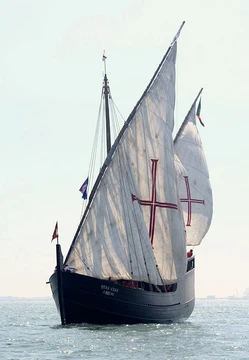
The caravel's lateen-sail rigging and shallow draft gave 15th-century Portuguese navigators the ability to sail upwind along the African coast, a capability that underpinned the entire Age of Exploration.
What is the 'passarola' and why does it matter?
In 1709, Bartolomeu de Gusmão flew a scaled model and then a full-sized manned balloon, the 'passarola,' in Lisbon, making it one of the earliest recorded heavier-than-air flight attempts in Europe.
How does the encyclopedia handle the telephone dispute?
It presents Ferreira's 1876 demonstration alongside Bell's and Gray's claims, notes the patent-timing overlap, and flags the entry as 'contested attribution' rather than declaring a single winner.
Which time period produced the densest cluster of Portuguese inventions?
The roughly 1700–1900 window saw the most concentrated output, spanning Gusmão's aviation work, Ferreira's telephony experiments, and Vasconcelos's radio research.
What is a commonly overlooked Portuguese contribution?
The carraca, or chip log, a simple device for estimating a ship's speed by counting knotted turns in a fixed interval, was refined and widely adopted by Portuguese mariners in the 15th century.
Does the encyclopedia include modern Portuguese engineering?
Yes, entries extend into the 20th and 21st centuries, covering contributions in telecommunications infrastructure, satellite technology, and biomedical device design from Portuguese researchers and firms.
How is this different from a standard history textbook?
It is community-written, prioritizes the inventor's story and the invention's mechanics over broad geopolitical context, and explicitly marks which claims are well-documented versus still debated among historians.