Carrack
A three- or four-masted ocean-going ship developed in 14th–15th century Europe.

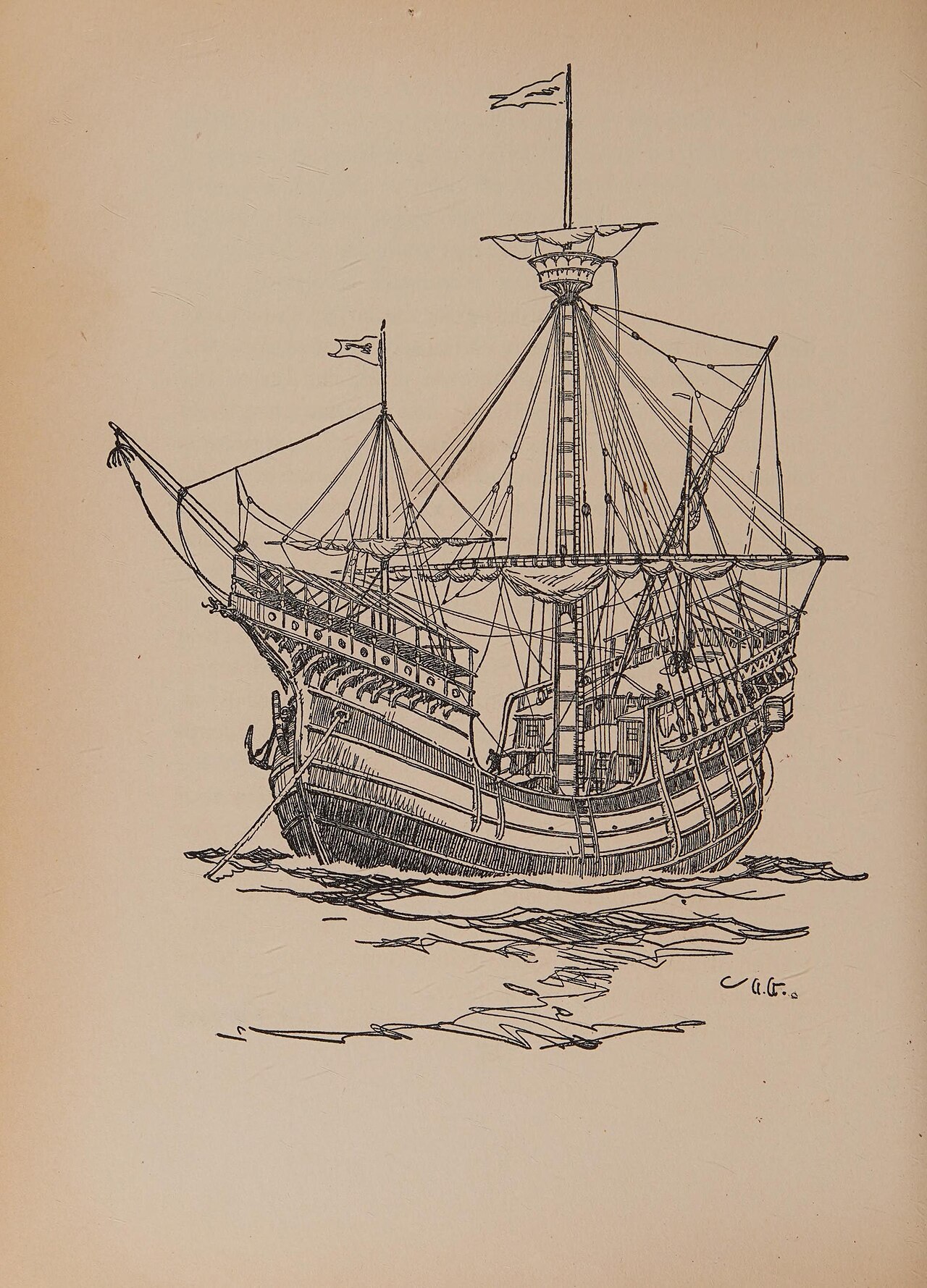
Gordon Grant (1875–1962); plates signed “G.G.” · Public domain
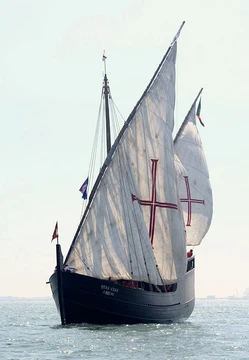
The carrack (Portuguese: nau; Spanish: nao; Catalan: carraca) is a three- or four-masted ocean-going sailing ship developed in the 14th to 15th centuries in Europe, most notably in Portugal and Spain. Evolving from the single-masted cog, the carrack was first used for European trade from the Mediterranean to the Baltic, and later for trade routes between Europe and Africa, the trans-Atlantic trade with the Americas, and trade between Europe, Africa and Asia starting in the late 15th century. It was gradually superseded in the late 16th and early 17th centuries by the galleon.
- Type
- Ocean-going sailing ship
- Origin
- Europe (notably Portugal and Spain)
- Period
- 14th to 17th centuries
- Masts
- Three or four
- Rigging
- Square-rigged on foremast and mainmast, lateen-rigged on mizzenmast
- Predecessor
- Cog
- Successor
- Galleon
Lore & Background
The carrack evolved from the single-masted cog and was first used for European trade from the Mediterranean to the Baltic. As Portuguese and Spanish navigators extended trade along Africa's Atlantic coast and islands during the 15th century, they needed larger, more durable ships for long oceanic ventures. They developed their own models of oceanic carracks from a fusion and modification of aspects of ship types known in both the Atlantic and Mediterranean, generalizing their use for inter-oceanic travel with advanced sail rigging and a hull shape that allowed larger cargoes. Portuguese carracks were often very large for their time, over 1000 tons displacement.
Reader's Guide
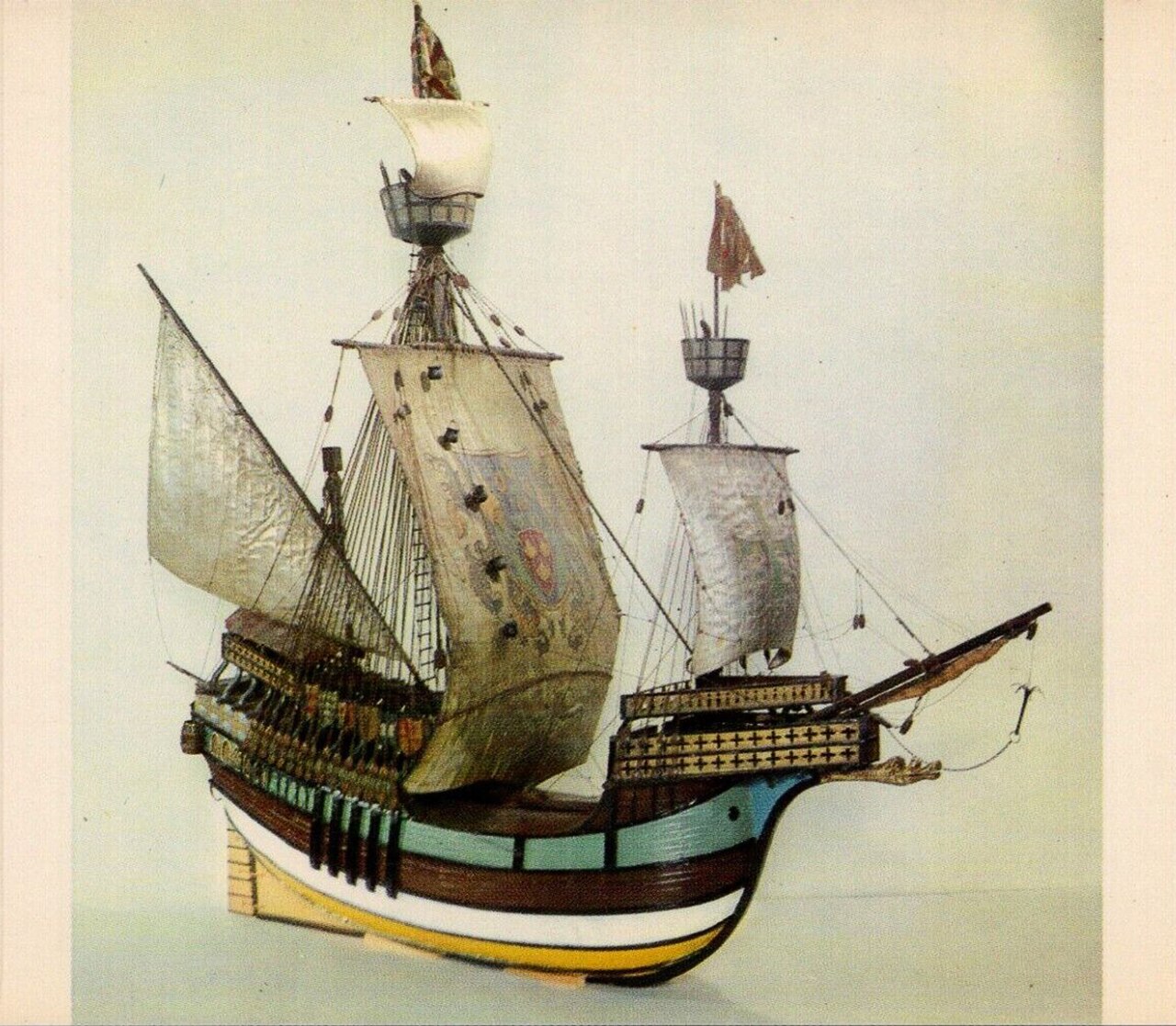
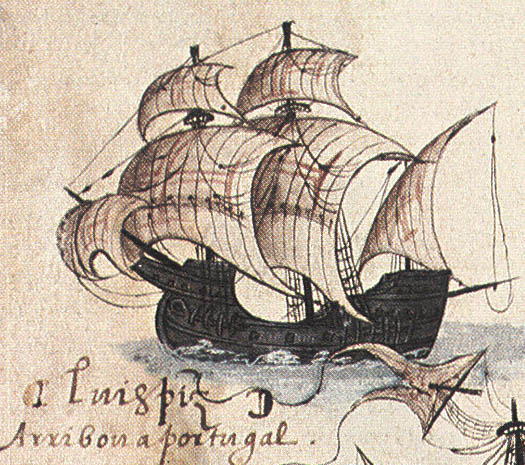
The carrack was one of the most influential ship designs in history, serving as the predecessor of the galleon. While ships became more specialized in following centuries, the basic design remained unchanged throughout this period. In its most developed form, the carrack was carvel-built, large enough to be stable in heavy seas, and capacious enough to carry large cargo and provisions for very long voyages. It had a high rounded stern with aftcastle, forecastle and bowsprit. The carrack enabled direct and regular exchanges between Europe and India starting in 1498 via the Cape Route, a voyage of about six months. On average, four carracks connected Lisbon to Goa carrying gold to purchase spices and pepper. From Goa, one carrack went on to Ming China for silks, and from 1541 the Portuguese traded with Japan, exchanging Chinese silk for Japanese silver. The Japanese called Portuguese carracks 'Black Ships' (kurofune), referring to the colour of the hulls. The Islamic world also built and used carrack-like ships, including Ottoman barca and Gujarati naos, which were often larger than Portuguese carracks.
Did You Know?
- The term 'carrack' may derive from Arabic qaraqir 'merchant ship', itself of unknown origin, possibly from Latin carricare 'to load a car' or Greek καρκαρίς 'load of timber'.
- A typical three-masted carrack such as the São Gabriel had six sails: bowsprit, foresail, mainsail, mizzensail and two topsails.
- The Japanese called Portuguese carracks 'Black Ships' (kurofune), referring to the colour of the ship's hulls.
- The carrack was gradually superseded in the late 16th and early 17th centuries by the galleon.
Origins & Development
The carrack emerged during the 14th and 15th centuries as European maritime powers sought vessels capable of ventures beyond familiar coastal waters. Its roots trace back to the single-masted cog, a workhorse of European trade between the Mediterranean and the Baltic. Portuguese and Spanish shipwrights, already familiar with Mediterranean galleys and two-masted caravels, began fusing elements from these diverse traditions. As Iberian traders pushed progressively farther down Africa's Atlantic coast during the 15th century, they needed something sturdier and larger for open-ocean crossings. The result was a hybrid: a hull shaped for heavy Atlantic swells, combined with a mixed sail plan that could handle powerful winds. Under King John II of Portugal, some of these vessels were already being built, though they became truly widespread only after the turn of the 16th century. By then, the carrack had transformed from a regional trade craft into a genuine ocean-going platform.
Design & Capabilities
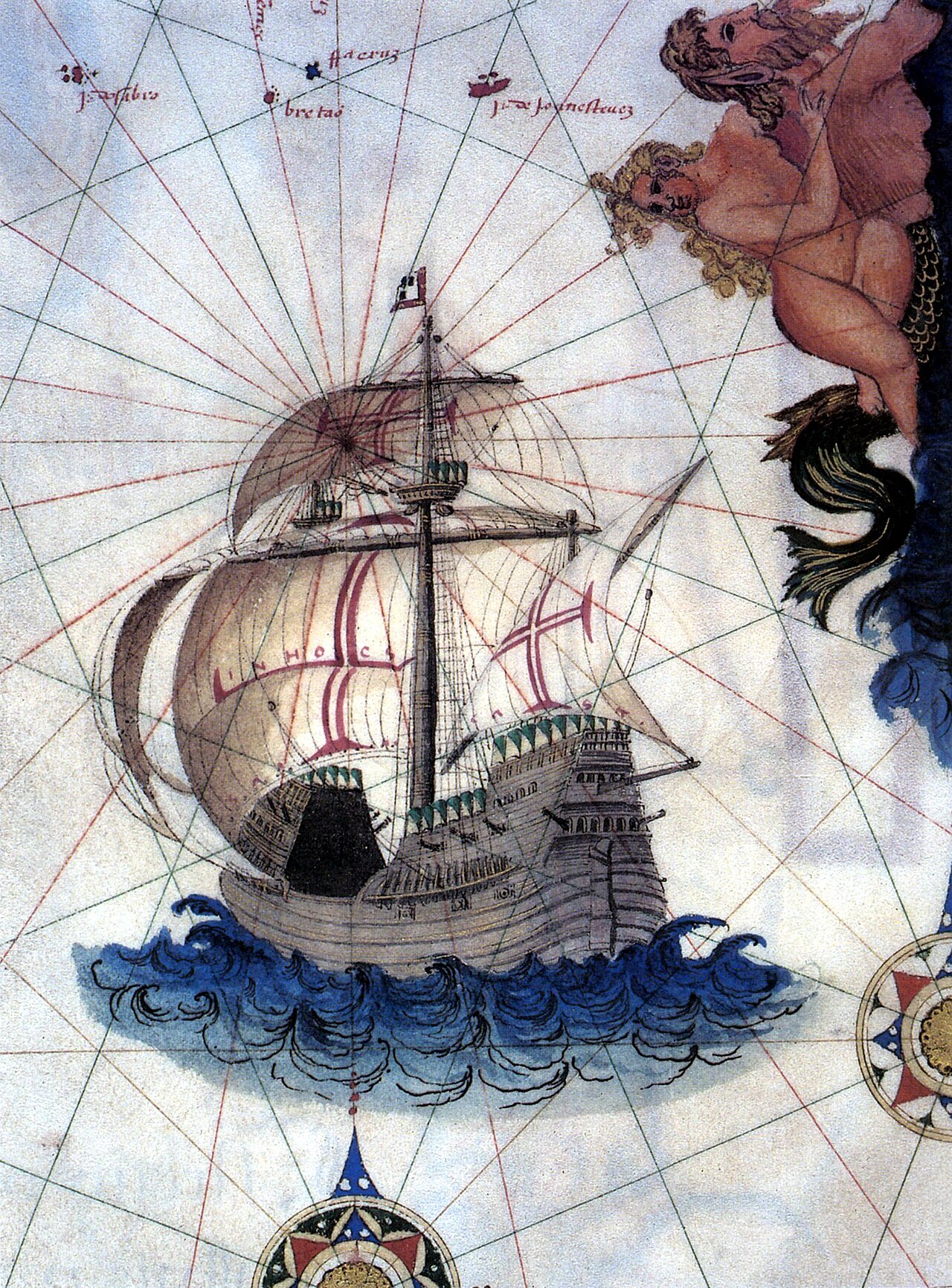
In its most refined form, the carrack was a carvel-built vessel engineered for both stability and capacity. Its hull was large enough to ride out heavy seas while still holding substantial cargo and the provisions required for voyages lasting months. The rigging combined square sails on the foremast and mainmast with a lateen sail on the mizzenmast, giving the ship superior maneuverability in the strong winds of the Atlantic. A high, rounded stern supported an aftcastle, while a forecastle and bowsprit anchored the bow. A typical three-masted example such as the São Gabriel carried six sails in total: the bowsprit sail, foresail, mainsail, mizzensail, and two topsails. Portuguese carracks were remarkably large for their era, frequently exceeding 1,000 tons of displacement. This combination of size, cargo space, and advanced rigging made the carrack the dominant ocean-going design of its time and the direct ancestor of the galleon that would eventually replace it.
The Asian Trade Routes
Beginning in 1498, Portugal opened a direct, regular sea link between Europe and India via the Cape Route—a journey of roughly six months that demanded the endurance and cargo capacity of a carrack. On average, four carracks shuttled between Lisbon and Goa, carrying gold to purchase pepper and other exotic goods. From Goa, a single carrack would continue to Ming China to acquire silks. In 1541, Portuguese traders extended this network to Japan, exchanging Chinese silk for Japanese silver. By 1550, the Portuguese Crown formalized this trade by auctioning the annual captaincy to Japan at Goa, granting one carrack exclusive trading rights per year. In 1557, the acquisition of Macau provided a permanent base for this partnership with Chinese merchants. The arrangement endured until 1638, when Japanese rulers banned the ships, citing the smuggling of Catholic priests. The Japanese themselves called these vessels Black Ships, or kurofune, for the dark color of their hulls—a term that later broadened to encompass any Western ship.
Legacy, Supersession & the Name
The carrack's influence on maritime history is difficult to overstate. As the direct predecessor of the galleon, it established a basic design template that persisted through centuries of naval development. The first galleons appeared in the mid-16th century, gradually displacing the carrack, yet carracks remained in service as late as the mid-17th century because of their superior cargo capacity. Even the Republic of Ragusa maintained its own version, the Dubrovačka karaka, for cargo transport from the 14th through the 17th century. The name itself carries a long linguistic journey: English carrack entered the language in the late 14th century via Old French caraque, from carraca, a term used across Spanish, Italian, and Middle Latin for large square-rigged vessels. The ultimate origin of carraca remains debated, with possible roots in Arabic, Greek, or even Sumerian, tracing back to ancient river barges. In Portuguese the ship was simply called nau, while the Dutch knew it as kraak.
Gallery
Frequently Asked Questions
What is a Carrack?
The carrack (Portuguese: nau) is a large ocean-going sailing vessel with three or four masts, widely regarded as one of the most important ship designs of the medieval and early modern eras. It served as the backbone of European maritime trade and exploration from the 14th through the 17th century.
Where and when was the Carrack developed?
The carrack was developed in 14th- and 15th-century Europe, with Portugal and Spain as the principal centers of its evolution. It grew out of the earlier single-masted cog, adding extra masts and a mixed rigging system to handle open-ocean conditions.
How is a Carrack rigged?
A carrack typically carries square-rigged sails on its foremast and mainmast, paired with a lateen-rigged sail on the mizzenmast. This combination gave the ship strong downwind speed while retaining enough maneuverability for variable winds.
What trade routes did the Carrack sail on?
Initially used for Mediterranean-to-Baltic commerce, the carrack was later pressed into service on routes linking Europe to Africa, the trans-Atlantic crossing to the Americas, and the long passages between Europe, Africa, and Asia. Its expanded role in the late 15th century made it central to the Age of Exploration.
What replaced the Carrack?
By the late 16th and early 17th centuries, the carrack was progressively superseded by the galleon. The galleon's more efficient hull shape and improved handling better suited the growing demands of long-distance trade and naval combat.
More in Portuguese inventions 1-18
Spotted an error? Know more?
This is a living reference — every entry is fact-audited, and reader corrections feed straight into our audit queue. Suggest an edit · See this site's audit record