Portuguese inventions
Portuguese inventions span navigation, military, and modern technology.

Great Britain. · Public domain
Portuguese inventions are creations by individuals born in Portugal or of Portuguese nationality, primarily developed during the Age of Discovery and in modern times. These inventions often relied on trade secrets, making documentation difficult, and some have been lost or destroyed, though specific claims about sword types during the French invasions lack clear historical support.
- field
- Navigation, military, computing, medicine
- nationality
- Portuguese
- known_for
- Mariner's astrolabe, regimento do astrolábio (rule of the astrolabe), espada preta (black sword), Via Verde, Multibanco, Zebinix
Lore & Background
During the Age of Discovery, Portuguese inventions focused on improving ocean navigation and coastal cartography, including the mariner's astrolabe and the regimento do astrolábio, a navigational table. Military innovations included cannons and sword types such as the espada preta (black sword). Many of these inventions were not patented due to reliance on trade secrets, and some documentation or objects may have been lost, though the destruction of specific sword types during the French invasions is not well-established in historical records.
Reader's Guide
Portuguese inventions reached their peak during the Age of Discovery, contributing to maritime exploration through devices like the mariner's astrolabe and chart of latitudes. In modern times, innovations expanded into computing and medicine, exemplified by Via Verde (automatic toll collection), Multibanco (multi-function ATM network), and the epilepsy drug Zebinix by Bial Laboratories. The difficulty in documenting these inventions stems from reliance on trade secrets and the destruction of records, such as during the French invasions, as well as the presence of Portuguese objects in private collections or museums abroad.
Did You Know?
- Portuguese inventions were created mainly during the Age of Discovery and modernity.
- Many Portuguese inventions are not described in patent documents due to reliance on trade secrets.
- The regimento do astrolábio was a key navigational table, sometimes misleadingly called a 'chart of latitudes'.
- Portuguese-origin objects exist in private collections or museums outside of Portugal.
Origins: From Reconquista to Ceuta (1139–1415)
The Kingdom of Portugal was born out of the Reconquista, the centuries-long Christian campaign to reclaim the Iberian Peninsula from Moorish rule. After establishing itself as a distinct kingdom in 1139 and completing the reconquest of Algarve by 1249, Portugal still lived under the shadow of its powerful Castilian neighbour until the Treaty of Ayllón in 1411 secured its borders. Freed from existential warfare and unlike other European states mired in internal conflict, Portugal turned its energy outward. Multiple motives converged: the military aristocracy craved battlefield glory and the spoils of war, the Church saw an opportunity to extend the crusade against Islam, and the crown needed new commercial arteries to counter domestic economic decline. In 1415 these pressures culminated in the assault on Ceuta, a strategically sited North African Muslim port that anchored the trans-Saharan gold and slave trade. The conquest was a military success and a symbolic first step beyond the peninsula, yet it quickly became a costly liability. Muslim forces besieged the town, trans-Saharan caravans simply rerouted to bypass it, and the Portuguese could not use Ceuta as a base for deeper expansion into the African hinterland.
The Age of Discovery and the Commercial Web (1418–1571)
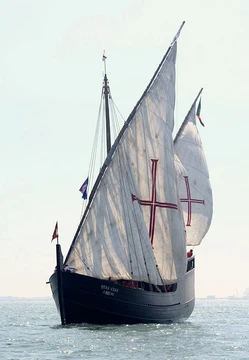
Although Ceuta disappointed economically, it anchored a far grander programme of maritime exploration. Infante Dom Henry the Navigator, a participant in the 1415 campaign, became the driving patron and financier of voyages along the Atlantic African coast until his death in 1460. At that time no European knew what lay beyond Cape Bojador, and Henry's twin goals were to map the full reach of Muslim Africa and to test whether a sea route to Asia's spice markets was possible. The technological foundations were already in place: advances in navigation, cartography, and the design of the caravel gave Portuguese crews the means to push into uncharted waters. The outcomes were extraordinary. In 1488 Bartolomeu Dias rounded the Cape of Good Hope and Cape Agulhas; in 1498 Vasco da Gama reached India; and in 1500 Pedro Álvares Cabral, en route to the Indian Ocean, made landfall on what would become Brazil. Over the following decades, Portuguese sailors charted the coasts and islands of East Asia, planting forts and trading factories as they went. By 1571 a continuous string of naval outposts linked Lisbon to Nagasaki across Africa, the Middle East, and South Asia. This commercial network accounted for roughly one-fifth of Portugal's per-capita income between 1500 and 1800, elevating a small Iberian kingdom into a global trading power.
The Iberian Union and the Rise of Brazil (1580–1822)
In 1580 the Portuguese crown passed to Philip II of Spain, who already ruled the most powerful state in Europe, inaugurating what later historians termed the Iberian Union. Though the two kingdoms kept separate administrations, the practical effect was devastating: Portuguese colonies now sat squarely in the crosshairs of three major powers hostile to Spain—the Dutch Republic, England, and France. Portugal's smaller population meant it simply could not field the naval and military resources required to defend its vast, scattered network of trading posts. A long, gradual decline set in. Yet within that contraction a new centre of gravity emerged. Brazil, an accidental find of 1500, grew into the most valuable colony of the second era of empire (1663–1825), its sugar, gold, and later coffee becoming the economic heart of the Portuguese world. That very centrality would prove its undoing. As independence movements swept the Americas in the early nineteenth century, Brazil declared its sovereignty in 1822, severing the empire's most lucrative thread and forcing Portugal to confront the reality that its global dominance was fading beyond recovery.
Decolonisation, the Carnation Revolution, and Legacy (1890–1999)
The empire's final act was defined by stubborn resistance followed by abrupt collapse. Under António de Oliveira Salazar's Estado Novo dictatorship (1932–1968), the regime clung to its remaining possessions—forts and plantations along the African coast, Portuguese Timor, enclaves in India, and Macau—renaming them 'overseas provinces' under the ideology of pluricontinentalism while retaining forced-labour systems that exempted only a small indigenous élite. The 1890 British Ultimatum had already curtailed Portuguese ambitions in Africa, and by the 1960s the regime's hold was crumbling. In 1961 Dahomey annexed the Fort of São João Baptista de Ajudá, and India absorbed Goa, Daman, and Diu. The Portuguese Colonial War in Africa raged from 1961 until the Carnation Revolution of April 1974 toppled the Estado Novo. Decolonisation followed in a rush: Portugal withdrew from its African territories, Indonesia annexed Timor in 1975, and a wave of Portuguese settlers and mixed-race residents fled the colonies. Macau was returned to China in 1999, closing nearly six centuries of imperial history. The Azores and Madeira, whose populations were overwhelmingly Portuguese, were reclassified as autonomous regions. The Community of Portuguese Language Countries (CPLP) stands as the Empire's cultural successor, analogous to the Commonwealth for former British territories.
Gallery
Frequently Asked Questions
What are Portuguese inventions?
Portuguese inventions are practical and technological creations developed by people born in Portugal or holding Portuguese nationality, stretching from the Age of Discovery to the present day. They span fields such as navigation, military engineering, computing, and medicine.
What are the most well-known Portuguese inventions?
Notable examples include the mariner's astrolabe and its companion rule book (regimento do astrolábio) for seafaring, the espada preta in military history, and modern systems like Via Verde, Multibanco, and Zebinix in computing and everyday technology.
Why is it so hard to find complete historical records of Portuguese inventions?
Many of these creations were guarded as trade secrets, which limited how much was written down publicly. On top of that, some documentation has been lost or destroyed over the centuries, and certain claims—like specific sword types tied to the French invasions—lack solid historical verification.
Which fields do Portuguese inventions primarily cover?
The main areas are navigation, military technology, computing, and medicine. These contributions appear in both historical contexts such as the Age of Discovery and in contemporary technological development.
Why are Portuguese inventions historically significant?
They were instrumental during the Age of Discovery, with tools like the mariner's astrolabe enabling long-distance ocean exploration. Their influence carries into the modern era through contributions to computing, payment infrastructure, and everyday technology used across Portugal and internationally.
More in Portuguese inventions 1-18
Spotted an error? Know more?
This is a living reference — every entry is fact-audited, and reader corrections feed straight into our audit queue. Suggest an edit · See this site's audit record